Claude training for Northland farm and orchard teams
Give the farm office a clear way to read, compare and prepare documents. Learn Claude with the records your team is permitted to use.
- Employees in farming and horticulture
- 4,539Northland, February 2025
- Share of Northland employees
- 6.8%12 of 16 regions
- Share across New Zealand
- 4.8%all regions, February 2025
- Location quotient
- 1.41×more concentrated than nationally
Farming and horticulture in Northland
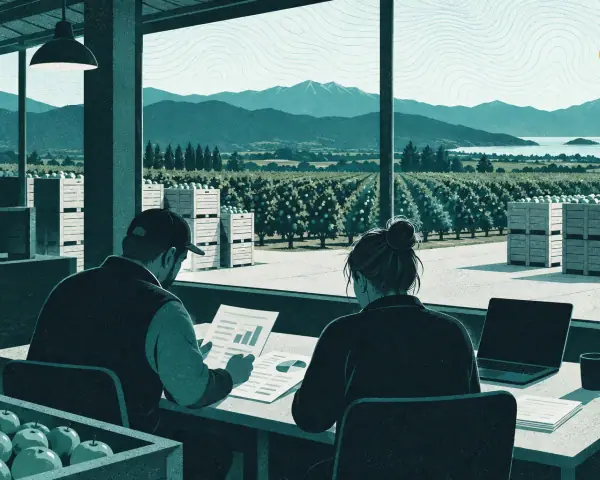
An orchard's harvest instructions, a farm's contractor agreement and a buyer's quality requirements all need careful reading. In training, we start with a generic Kerikeri grower preparing a crew pack from approved material. The useful result is a draft that points back to its evidence and makes unanswered questions visible.
Claude Projects can hold reference files and specific instructions for this work.6 TheColab teaches the person reviewing the output to check names, versions and exceptions before anyone acts on it. We can come to your Northland workplace or teach remotely, with exercises for managers and office staff.
Paid employees in farming and horticulture went from 5,447 in February 2020 to 4,539 in February 2025 (−16.7%).
Share of paid employees in farming and horticulture, by region
| Region | Chart | Share | NZ | × |
|---|---|---|---|---|
| Tasman | 20.7% | 4.8% | 4.3× | |
| Gisborne | 19.6% | 4.8% | 4.1× | |
| Marlborough | 16.1% | 4.8% | 3.3× | |
| Southland | 15.0% | 4.8% | 3.1× | |
| Hawke's Bay | 13.2% | 4.8% | 2.7× | |
| Bay of Plenty | 8.6% | 4.8% | 1.8× | |
| Waikato | 8.2% | 4.8% | 1.7× | |
| Otago | 7.9% | 4.8% | 1.6× | |
| Manawatū-Whanganui | 7.6% | 4.8% | 1.6× | |
| Taranaki | 7.2% | 4.8% | 1.5× | |
| West Coast | 7.2% | 4.8% | 1.5× | |
| Northland (this page) | 6.8% | 4.8% | 1.4× | |
| Canterbury | 5.0% | 4.8% | 1.0× | |
| Nelson | 4.9% | 4.8% | 1.0× | |
| Wellington | 1.1% | 4.8% | 0.2× | |
| Auckland | 0.7% | 4.8% | 0.1× |
Paid employees at business locations in the region, February 2025. The tick marks the national share. × is the regional share divided by the national share.
Source: Stats NZ, Business Demography Statistics, February 2020 and 2025.
Local context
- Northland's growing mix includes kiwifruit, Far North citrus and avocado development.2 T&G Global identifies berry and citrus work at Kerikeri, while Seeka recruits for local orchards and packhouses.3,4 These operations illustrate the region's seasonal document needs; they are not named training customers.2,3,4
- Northland NZ publishes crop feasibility reports and financial calculators with due-diligence cautions.5 A workshop can practise reading assumptions from those public materials without treating a draft as a land-use recommendation.5
Organisations are named for local context only. No relationship with them is implied.
Towns in Northland
Each town page has its own figures and local brief.
Or see Claude training across Northland.
Where Claude helps farming and horticulture teams
A crew pack with traceable instructions
Place the current induction guide and supervisor-approved task notes in a Project. Ask for a plain-language welcome pack, with a reference beside each instruction and a separate list of missing details.6 In the Kerikeri exercise, participants check where orchard work ends and packhouse responsibility begins before the manager approves the pack.
- Orchard administrator and crew supervisor
- Projects and project knowledge
Read a buyer document beside your own process
Provide the full approved buyer specification and the business's existing procedure. Request a comparison table of matching sections, differences and questions, rather than a verdict on compliance. Claude can use uploaded documents as context.6 Staff verify each quoted passage, retain the original document and send technical questions to the responsible adviser.
- Grower liaison or farm manager
- Long documents in Projects
An interactive seasonal reference
Build an artifact that lets office staff browse reviewed task notes by crop and responsibility. Anthropic supports small interactive tools as artifacts.7 Use demonstration content during the workshop. Test an unknown task and an outdated instruction so the prototype makes its limits obvious. The supervisor remains the source for operational decisions.
- Seasonal coordinator
- Artifacts
Check a record-import utility
For a business with a developer, Claude Code can inspect a small import script and help add checks for missing block names or inconsistent dates. Repository edits and tests are documented capabilities.8 Practise on synthetic harvest records, review the proposed changes and compare the resulting file with the untouched input before considering live use.
- Developer supporting the farm office
- Claude Code
Prepare a reviewed orchard briefing
- Select the current approved source pack and record the document owner.
- Remove personal crew details from the practice files.
- Ask for the briefing, its evidence references and unresolved questions as separate outputs.
- Compare each operational instruction with its source and have the supervisor resolve omissions.
- Save the approved version with its review note so the next season starts from a known record.
Courses
1Introductory
Claude foundations workshop
A hands-on first session for the whole team: prompts with real context, Projects, files, artifacts and the habit of checking answers.
2Organisation
Claude team rollout
Move from a few keen users to a whole team using Claude well: plan and seats, Projects structure, usage rules, connectors, Skills and champions.
3Advanced
Claude Code and MCP for developers
For developers and technical leads: agentic coding with Claude Code, team settings and permissions, building an MCP server, and the Claude API.
Farming and horticulture in other regions
- Auckland
- Canterbury
- Wellington
- Waikato
- Bay of Plenty
- Manawatū-Whanganui
- Otago
- Taranaki
- Southland
- Tasman
- Nelson
- Gisborne
- Marlborough
- West Coast
Other industries in Northland
- Manufacturing
- Construction and trades
- Retail
- Tourism and hospitality
- Transport and logistics
- Professional services
- Health
- Education
- Government
See Claude for farming, horticulture and forestry across New Zealand, or all training in Northland.
Farming and horticulture in Northland: questions
Can an office team start without coding?
Office staff can begin with document comparison and Project instructions.6 We introduce developer tooling only when someone has the skills and responsibility to maintain the resulting software.
Does this cover dairy as well as fruit growing?
We can shape an exercise around a farm's approved contractor notes or buyer correspondence. Northland has dairy, beef and sheep operations as well as horticulture.1 Bring a task that needs a human review.
Will the reference tool run the harvest?
An artifact is a prototype for presenting information.7 It should show approved material and route missing answers to a supervisor, who controls the work and checks each update.
What should a manager bring?
Choose a current document, an acceptable example output and a list of information that cannot be uploaded. We use these to set a useful exercise and agree who signs off the draft.
Train your farming and horticulture team in Northland
- You tell us about the teamSize, where you are, the documents people work with, and what you would like to change.
- We suggest a course and formatBy email, with a few questions about the tasks and documents you want to train on.
- People practise on real workOn-site or remote. Everyone leaves with Claude set up for tasks they do every week.
- In person
- Remote
- Half-day workshop
- Full-day workshop
- Team rollout
Independent training by TheColab. Not affiliated with Anthropic.
Enquire
Tell us about your team in Northland. We reply by email with a suggested course and format.
Sources
Written 6 October 2026. Employment figures come from Stats NZ Business Demography Statistics.
- 1. Pastoral Farming, Northland NZ (accessed 2026-10-06)
- 2. Horticulture & Fruit Growing, Northland NZ (accessed 2026-10-06)
- 3. Kerikeri, T&G Global (accessed 2026-10-06)
- 4. Work at Seeka, Seeka (accessed 2026-10-06)
- 5. Grow Northland crop studies and financial models, Northland NZ (accessed 2026-10-06)
- 6. What are projects?, Anthropic (accessed 2026-10-06)
- 7. What are artifacts and how do I use them?, Anthropic (accessed 2026-10-06)
- 8. Claude Code: Common developer use cases, Anthropic (accessed 2026-10-06)