Claude for Taranaki manufacturing and food processing
Put careful document work at the centre of your AI training. Learn to use Claude for specification reviews, procedure drafts and small tools that staff can inspect.
- Employees in manufacturing
- 8,587Taranaki, February 2025
- Share of Taranaki employees
- 16.0%1 of 16 regions
- Share across New Zealand
- 9.4%all regions, February 2025
- Location quotient
- 1.69×more concentrated than nationally
Manufacturing in Taranaki
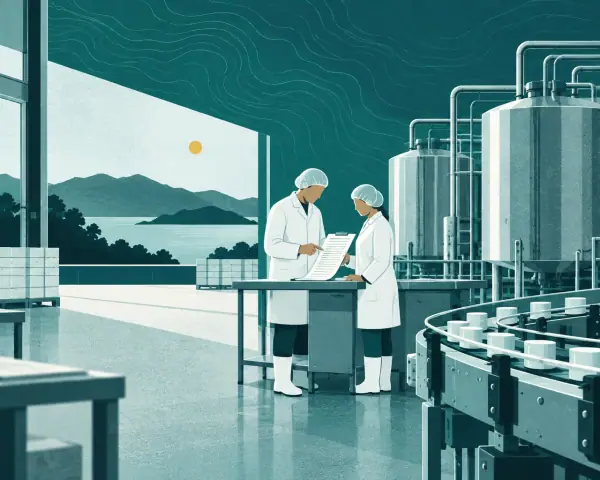
A fictional Waitara food manufacturer receives a revised customer specification while an older procedure remains in the shared folder. The training task is to compare the documents, identify conflicts and prepare questions for the quality lead. Claude should expose a mismatch clearly without deciding which production instruction is safe.
TheColab runs practical sessions at your Taranaki workplace. Quality staff, supervisors and technical teams can work on different outputs from the same approved document pack. We teach learners to inspect evidence, record unresolved issues and keep publication authority with the person responsible for the process.
Paid employees in manufacturing went from 8,773 in February 2020 to 8,587 in February 2025 (−2.1%).
Share of paid employees in manufacturing, by region
| Region | Chart | Share | NZ | × |
|---|---|---|---|---|
| Taranaki (this page) | 16.0% | 9.4% | 1.7× | |
| Southland | 16.0% | 9.4% | 1.7× | |
| Marlborough | 15.6% | 9.4% | 1.6× | |
| Hawke's Bay | 12.7% | 9.4% | 1.4× | |
| West Coast | 12.4% | 9.4% | 1.3× | |
| Waikato | 11.5% | 9.4% | 1.2× | |
| Canterbury | 10.8% | 9.4% | 1.1× | |
| Tasman | 10.8% | 9.4% | 1.1× | |
| Manawatū-Whanganui | 10.7% | 9.4% | 1.1× | |
| Nelson | 9.3% | 9.4% | 1.0× | |
| Bay of Plenty | 9.1% | 9.4% | 1.0× | |
| Auckland | 9.0% | 9.4% | 0.9× | |
| Northland | 8.5% | 9.4% | 0.9× | |
| Otago | 7.5% | 9.4% | 0.8× | |
| Gisborne | 7.3% | 9.4% | 0.8× | |
| Wellington | 4.4% | 9.4% | 0.5× |
Paid employees at business locations in the region, February 2025. The tick marks the national share. × is the regional share divided by the national share.
Source: Stats NZ, Business Demography Statistics, February 2020 and 2025.
Local context
- ANZCO's Waitara operation produces patties, jerky, mince and diced beef for domestic and overseas markets. Fonterra identifies cheese, butter, casein and powders at Whareroa, showing the region's range of processing work.1,2
- The Taranaki Alliance helps industrial businesses pursue larger commercial opportunities. Its coordination role makes capability documents relevant, while delivery contracts stay with the participating firms.3
Organisations are named for local context only. No relationship with them is implied.
Towns in Taranaki
Each town page has its own figures and local brief.
Or see Claude training across Taranaki.
Where Claude helps manufacturing teams
Trace a changed specification
Place the issued specification and approved procedure in a Claude Project with their version dates. Ask for a comparison that lists the original clause, the revised wording and the affected instruction. Require an uncertainty entry wherever the documents do not establish an answer. A technical reviewer follows the references and decides whether the procedure needs a formal change.4
- Quality assurance lead
- Claude Projects and long document comparison
Write a procedure from reviewed notes
Give Claude an authorised supervisor's outline and the controlled procedure format. Ask it to draft the sequence, separate warnings from actions and list missing process details at the end. Tell it to leave temperatures, tolerances and settings untouched unless supplied in the source. The process owner checks the draft at the workstation before it enters the normal document-control process.4
- Production supervisor
- Project instructions and document drafting
Prototype a product induction view
Use Claude artifacts to explore a simple internal training screen from fictional product notes. Learners choose a product family and see the approved handling information alongside its source label. Try incomplete records and a conflicting instruction. The prototype should display uncertainty clearly; a reviewer must approve both the interface and content before it supports actual staff induction.5
- Factory training coordinator
- Claude artifacts
Validate a production-data export
With Claude Code, a developer can draft a small script that checks sample batch exports for missing identifiers, duplicate records and invalid dates. Supply the expected schema and keep the original files read only. Test deliberate errors alongside valid samples, then review the code and output. Any later connection to live systems needs a separate technical decision by the manufacturer.6
- Manufacturing developer or analyst
- Claude Code
Review a specification change before drafting
- Choose a permitted document pair and record which version the customer issued and which version the plant currently uses.
- Ask Claude for a clause-by-clause comparison with evidence references and a list of gaps in the supplied material.
- Have a subject specialist check each proposed conflict and classify it as a change, an ambiguity or a false match.
- Use the checked list to prepare a draft update, then seek the usual quality and process approvals.
Courses
1Introductory
Claude foundations workshop
A hands-on first session for the whole team: prompts with real context, Projects, files, artifacts and the habit of checking answers.
2Organisation
Claude team rollout
Move from a few keen users to a whole team using Claude well: plan and seats, Projects structure, usage rules, connectors, Skills and champions.
3Advanced
Claude Code and MCP for developers
For developers and technical leads: agentic coding with Claude Code, team settings and permissions, building an MCP server, and the Claude API.
Manufacturing in other regions
- Auckland
- Canterbury
- Wellington
- Waikato
- Bay of Plenty
- Manawatū-Whanganui
- Otago
- Northland
- Southland
- Tasman
- Nelson
- Gisborne
- Marlborough
- West Coast
Other industries in Taranaki
- Farming and horticulture
- Construction and trades
- Retail
- Tourism and hospitality
- Transport and logistics
- Professional services
- Health
- Education
- Government
See Claude for manufacturing and food processing across New Zealand, or all training in Taranaki.
Manufacturing in Taranaki: questions
Can we use a full customer specification?
First confirm that your business permits the document in the selected account. For training, a redacted excerpt with its relevant annexes may be enough. Projects can hold source material, but access permission still needs a business decision.4
Will an artifact replace our training system?
Treat it as a prototype for discussion. Artifacts can present documents or interactive tools, which helps staff inspect an idea. Your trainer must still check the instructions and decide how an approved version should be maintained.5
Does every attendee need coding experience?
Document review suits supervisors and quality staff without development skills. Claude Code work belongs with someone who can inspect a repository, test a script and review changes before use. Those exercises can run as a separate technical session.6
How do engineering suppliers fit this training?
Bring an approved capability statement and a public or permitted tender excerpt. The Alliance's larger-contract focus gives a local context for practising evidence-backed bid responses. Confirm every capability and commitment before submitting a proposal.3
Train your manufacturing team in Taranaki
- You tell us about the teamSize, where you are, the documents people work with, and what you would like to change.
- We suggest a course and formatBy email, with a few questions about the tasks and documents you want to train on.
- People practise on real workOn-site or remote. Everyone leaves with Claude set up for tasks they do every week.
- In person
- Remote
- Half-day workshop
- Full-day workshop
- Team rollout
Independent training by TheColab. Not affiliated with Anthropic.
Enquire
Tell us about your team in Taranaki. We reply by email with a suggested course and format.
Sources
Written 6 October 2026. Employment figures come from Stats NZ Business Demography Statistics.
- 1. Fonterra continues to invest for future, Fonterra (accessed 2026-10-06)
- 2. ANZCO Foods Waitara, ANZCO Foods (accessed 2026-10-06)
- 3. Taranaki Alliance, Venture Taranaki (accessed 2026-10-06)
- 4. What are projects?, Anthropic (accessed 2026-10-06)
- 5. What are artifacts and how do I use them?, Anthropic (accessed 2026-10-06)
- 6. Claude Code overview, Anthropic (accessed 2026-10-06)